Key Takeaways
- TMB peaks late December to mid-January — the 7–8 week buildup phase after shoot emergence in November gives growers a defined window for targeted intervention before populations hit threshold.
- Night temperature of 23–24 °C is the strongest outbreak predictor — ICAR-CPCRI field data from coastal Karnataka (2022–24) showed minimum temperature alone explained 51–55% of TMB population variation across two seasons.
- Pods attract the most feeding bugs (5.17/plant part), but cherelles receive the most eggs (3.67/cherelle) — female TMB strategically oviposits on thin-skinned cherelles to maximise nymph survival, making cherelle-stage protection critical.
- Scout between 0600 and 0800 h for accurate counts — TMB feeding activity drops sharply by midday; afternoon scouting underestimates infestation by a wide margin.
- Yield loss reaches 40% normally and 70–80% in epidemics — timely action during shoot and cherelle formation, before threshold levels, is the most cost-effective strategy for smallholder and plantation cocoa alike.
What Is the Tea Mosquito Bug (*Helopeltis theivora*)?
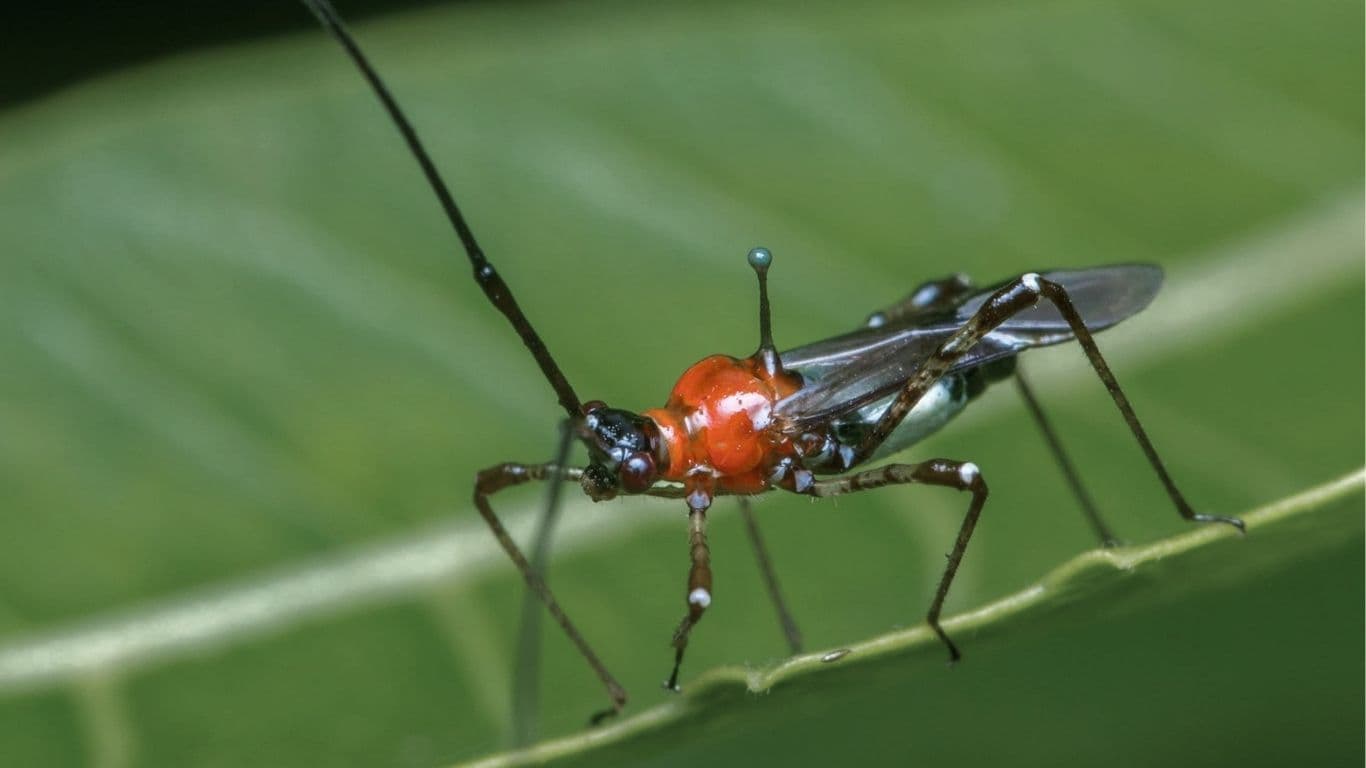
Tea mosquito bug (TMB) is a sap-sucking insect in the family Miridae (Hemiptera) that ranks among the most economically damaging pests of cocoa in tropical Asia. Both nymphs and adults pierce plant tissue with their proboscis, creating characteristic necrotic spots at each feeding site.
On cocoa, TMB attacks three structures: tender shoots (causing dieback), cherelles (immature pods up to 90 days old), and mature pods (causing dark circular lesions that harden into scars, plus pod malformation and premature drop). Over 40 host plants have been documented globally, including tea, cashew, pomegranate, and numerous weeds.
TMB's host-switching behaviour is agronomically significant. During the off-season (April–October), the bug survives on weeds such as *Mikania micrantha*, *Clidemia hirta*, *Amaranthus* spp., and *Plectranthus amboinicus* near cocoa orchards. These serve as reservoir habitats from which TMB recolonises cocoa when new flushes appear.
Why Does Tea Mosquito Bug Threaten Indian Cocoa Production?
TMB is the primary entomological constraint on cocoa yields in India's four main producing states — Karnataka, Kerala, Tamil Nadu, and Andhra Pradesh. Yield reduction is estimated at 40% under routine infestation and 70–80% during epidemic outbreaks (Babin et al., 2012).
Cocoa is a high-value cash crop that supports export revenue and rural employment across southern India. TMB-driven losses directly erode grower income, and the damage is cumulative: feeding punctures reduce pod quality, while egg-laying on cherelles compromises the next generation of developing fruits.
Overreliance on synthetic insecticides has compounded the problem. Repeated chemical applications have led to documented resistance in TMB populations and environmental contamination in plantation ecosystems. This makes ecology-based, timing-driven management — grounded in the pest's field behaviour — essential for sustainable cocoa production.
When Does Tea Mosquito Bug Attack Cocoa in India?
TMB activity on cocoa follows a unimodal seasonal pattern — a single population peak per year — driven by crop phenology and post-monsoon weather. This differs from tea and cashew, where TMB typically shows two peaks (December and June) coinciding with flushing and flowering.
The seasonal timeline based on two years of ICAR-CPCRI field monitoring at Vittal, coastal Karnataka (12°15′ N, elevation 73–92 m, annual rainfall 3600–4000 mm):
1. September: Trees are pruned to regulate canopy density, improve airflow, and stimulate synchronised flowering and pod development.
2. Late October–early November: New shoots emerge 25–30 days post-pruning. Adult TMB colonises tender flushes almost immediately.
3. November–mid-December: Population builds steadily over 7–8 weeks as cherelles form and pods develop. Incidence ranges from 47% (shoots) to 85% (pods).
4. Late December–third week of January: Population reaches peak. This coincides with maximum cherelle and pod availability and optimal night temperatures (23–24 °C).
5. Late January–March: Bug numbers decline gradually. Only scattered individuals remain by late March as pod maturation concludes.
6. April–October: No or minimal TMB activity on cocoa. The south-west monsoon (June–September) and absence of preferred feeding substrates drive the off-season gap.
> Field insight: The off-season gap is a management opportunity. Removing known alternative weed hosts — *Mikania micrantha*, *Clidemia hirta*, *Cyclea peltata*, *Dioscorea* spp. — from the orchard periphery reduces the reservoir population that recolonises cocoa in November.
How Does Tea Mosquito Bug Feed on Cocoa During the Day?
TMB feeding follows a consistent diurnal rhythm across seasons, peaking in the early morning and declining through midday. Practical scouting programmes must align with this activity window to produce accurate counts.
ICAR-CPCRI researchers recorded bug activity at 2-hour intervals from 0600 to 1800 h across both seasons:
- 0600–0800 h: Maximum (peak feeding). Best scouting window — most bugs visible on shoots, cherelles, and pods
- 0800–1000 h: Declining. Still useful for scouting, though counts begin to drop
- 1000–1400 h: Lowest. Bugs retreat to shaded canopy interior — scouting here underestimates population
- 1400–1800 h: Slight rebound. Modest increase toward evening, but well below morning peak
This pattern held in both 2022–23 and 2023–24, though total counts were higher in the second season. The early-morning peak aligns with the presence of dew and minimum canopy temperatures — conditions that favour TMB movement and feeding.
Which Cocoa Plant Parts Does TMB Prefer for Feeding?
Pods attract the highest TMB feeding pressure, followed by cherelles and then shoots. This preference hierarchy is statistically significant (F = 27.58, P < 0.001) and consistent across both seasons.
- Pods (mature): 5.17 ± 0.69 bugs/observation, 79–85% incidence
- Cherelles (immature pods <90 days): 2.92 ± 0.34 bugs/observation, Intermediate incidence
- Shoots (tender flushes): 2.04 ± 0.28 bugs/observation, 47–64% incidence
The pod preference is likely nutritional. Laboratory studies confirm that TMB reared on cocoa pods shows shorter developmental periods, higher survival rates, and greater fecundity compared to those reared on cherelles or shoots.
On the ground, this means growers should not wait until pod damage is visible to begin control. By the time dark circular lesions and scarring appear on pods, the population has already been feeding and reproducing for weeks.
Where Does TMB Lay Eggs on Cocoa — and Why?
Female TMB lays maximum eggs on cherelles despite feeding most heavily on mature pods. This separation of feeding and oviposition sites is a deliberate reproductive strategy guided by the optimal oviposition theory — females select egg-laying substrates that maximise offspring fitness, not necessarily the ones they prefer for feeding.
- Cherelles: 3.67 ± 0.41 eggs/observation. Thin exocarp (0.1–0.3 cm) allows nymph stylets to penetrate immediately after hatching.
- Pods: 2.57 ± 0.25 eggs/observation. Thicker husk (1–3 cm) makes nymph feeding harder; still used when cherelle availability drops.
- Shoots: 0.93 ± 0.20 eggs/observation. Least preferred — limited nutritional substrate for sustained nymph development.
Eggs are laid singly or in small clusters of 2–4, embedded inside plant tissue via the ovipositor. Each egg is identifiable by two tiny chorionic processes — the operculum and a respiratory horn — protruding from the surface.
In practice, this means cherelle-stage protection is as critical as pod-stage protection for breaking the TMB reproduction cycle. Growers who focus exclusively on mature pod damage miss the primary oviposition substrate.
Does TMB Lay More Eggs During Day or Night?
Female TMB lays significantly more eggs during daylight hours (photophase) than at night (scotophase). Laboratory trials at ICAR-CPCRI using 30 mating pairs confirmed this: the mean was 21.9 eggs per female during photophase versus 3.1 during scotophase (F = 64.41, P < 0.001).
This finding has a management implication. Daytime canopy disturbance — from scouting, harvesting, or spray operations — does not suppress oviposition; females lay regardless of moderate daytime activity. Control strategies must reduce adult numbers rather than rely on behavioural disruption.
What Weather Conditions Trigger TMB Outbreaks on Cocoa?
Minimum night temperature in the 23–24 °C range is the single strongest predictor of TMB population peaks on cocoa. All four monitored weather parameters showed negative correlations with bug numbers, but only minimum temperature reached statistical significance.
The negative correlation reflects the seasonal pattern: TMB populations build during the cooler post-monsoon window (November–January) when night temperatures settle into the optimal 23–24 °C band. As the season warms through February–March, populations decline.
Regression models incorporating all four weather variables explained 51–62% of population variation across seasons. Partial-dependence analysis added further detail:
- Relative humidity up to ~77% shows a modest positive association with TMB activity. Beyond that threshold, the effect plateaus.
- No or minimal rainfall supports peak activity. Even moderate precipitation suppresses field movement and feeding.
- Maximum temperature has a non-linear effect, with no clear threshold identified.
> Pro tip for growers: Begin tracking your local minimum night temperatures from the first week of November. When Tmin settles consistently at 23–24 °C, increase scouting to twice weekly. This gives you a 2–3 week lead-time before populations reach peak, allowing pre-emptive intervention at the shoot-to-cherelle stage.
Can I Control Tea Mosquito Bug on a 1–2 Hectare Cocoa Farm?
Yes. Weather-aware scouting and phenology-based timing are more effective than calendar spraying and require fewer inputs. Here is a step-by-step approach suitable for small and medium cocoa holdings:
1. Prune canopy in September to synchronise flush emergence, improve airflow, and concentrate the TMB activity window for targeted management.
2. Begin weekly scouting in the first week of November when new shoots appear. Walk a W-pattern across the plot. Inspect 3 shoots, 3 cherelles, and 3 pods per plant on at least 50 plants per hectare.
3. Scout between 0600 and 0800 h only — counts taken after 1000 h will underestimate the true population.
4. Track minimum night temperature using a simple min-max thermometer or local weather station data. When Tmin reaches 23–24 °C consistently, switch to twice-weekly scouting.
5. Intervene at the shoot-to-cherelle stage — before populations reach threshold. A single well-timed targeted spray at this stage disrupts both feeding damage and the egg-laying cycle on developing pods.
6. Remove alternative weed hosts from the orchard perimeter. Key species to target: *Mikania micrantha*, *Clidemia hirta*, *Amaranthus* spp., *Cyclea peltata*, and *Dioscorea* spp.
7. Conserve natural enemies where possible. Known TMB biocontrol agents include the assassin bug *Cydnocoris gilvus*, lynx spider *Oxyopes javanus*, egg parasitoid *Telenomus* sp., and entomopathogens *Beauveria bassiana* and *Metarhizium anisopliae*.
The cost of this timing-based approach is substantially lower than fortnightly calendar spraying. A single precisely timed application replaces 3–4 routine sprays, reducing both input costs and insecticide resistance risk.
Regional Considerations for Cocoa Growers Across South India
The field data in this article comes from ICAR-CPCRI's Regional Station at Vittal, coastal Karnataka — a high-rainfall zone (3600–4000 mm annually) with distinct monsoon seasonality. Growers in other cocoa regions should adjust expectations:
Coastal Karnataka and Kerala — Annual rainfall exceeds 3500 mm, creating a defined TMB-free monsoon window (June–September). Post-monsoon buildup starts reliably in November. The Vittal data applies most directly to these zones.
Tamil Nadu (inland plantations) — Lower annual rainfall and different diurnal temperature ranges may shift peak timing by 1–2 weeks in either direction. Local scouting data should override generalised calendars.
Andhra Pradesh — Drier Rabi-season conditions can produce earlier, sharper TMB peaks. Night temperatures may reach the 23–24 °C threshold sooner, warranting earlier scouting initiation.
Across all regions, the core principle holds: when your minimum night temperature enters the 23–24 °C range, TMB outbreak risk is imminent.