# Pulse Beetle Control in Stored Chickpea: Botanicals and Safer Insecticides Compared
> Spinosad and emamectin benzoate deliver 100% adult mortality and limit grain damage to under 22% over 120 days in stored chickpea, while Ageratum conyzoides is the most effective botanical alternative for pulse beetle (*Callosobruchus chinensis*) management.
Key Takeaways
- Spinosad outperforms all treatments — it achieves 100% beetle mortality, restricts grain damage to 18.33%, and preserves 77% seed germination after 120 days of chickpea storage.
- Ageratum conyzoides is the top botanical — at 10 g/kg seed, it reduces beetle emergence to 39.33 adults (versus 245.67 in untreated grain) and limits grain damage to 23% over 120 days.
- Untreated chickpea loses nearly everything — 93.67% grain damage, 39.74% weight loss, and germination dropping to 9.33% within four months of storage.
- Neem leaf powder underperforms expectations — despite its widespread use, *Azadirachta indica* powder does not significantly restrict population build-up or grain damage over prolonged storage.
- Rabi-harvested chickpea in Himachal Pradesh enters warm storage conditions where *C. chinensis* populations multiply rapidly, making early treatment essential.
What Is the Pulse Beetle (*Callosobruchus chinensis*)?
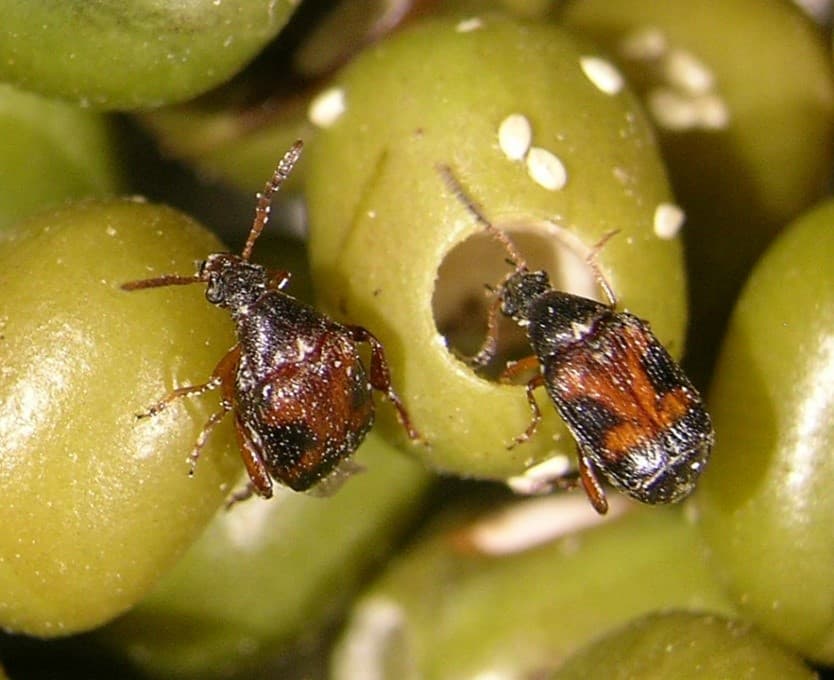
Pulse beetle (*Callosobruchus chinensis*) is a stored-grain insect pest belonging to the family Chrysomelidae (subfamily Bruchinae) that infests chickpea, green gram, black gram, and other pulses during storage. Larvae develop inside individual seeds, feeding on the cotyledons and leaving characteristic exit holes upon adult emergence.
Infestation typically begins at low levels during harvest but escalates rapidly in storage due to continuous breeding. Under warm conditions (26 ± 2°C, 70% relative humidity), populations double within weeks, leading to compounded grain damage, weight loss, and loss of seed viability.
In India, post-harvest pulse losses from bruchid infestation can reach alarming levels. This is especially problematic for chickpea stored as seed material, where both weight and germination must be preserved [EXTERNAL LINK: ICAR — Indian Institute of Pulses Research, Kanpur].
Why Pulse Beetle Management Matters for Indian Chickpea Farmers
India is the world's largest producer and consumer of chickpea. Most smallholder farmers store Rabi-harvested chickpea (March–April) for 3–6 months for consumption, sale at better prices, or as seed for the next season.
Without treatment, a 120-day storage trial conducted at CSK Himachal Pradesh Agricultural University, Palampur, found that untreated chickpea suffered 93.67% grain damage and 39.74% weight loss. Seed germination fell from healthy levels to just 9.33%.
These losses directly affect food security, seed availability, and farmer income. Traditional storage systems in hilly regions of Himachal Pradesh rarely incorporate effective pest management, making stored chickpea particularly vulnerable.
[INTERNAL LINK: Post-harvest storage losses in Indian pulses]
How Were the 12 Treatments Tested?
Researchers at the Department of Entomology, CSK HPAU, Palampur (elevation 1,250 m), evaluated 10 botanical leaf powders and 2 novel insecticides against *C. chinensis* in a completely randomised design with three replications.
1. Botanical powders (10 plant species) were prepared from shade-dried leaves (roots for *Saussurea lappa*), ground into fine powder, and mixed at 10 g per kg of chickpea seed (variety Himachal Chana 2).
2. Spinosad 45% SC was applied at 0.045% a.i. per 100 g seed.
3. Emamectin benzoate 1.9% EC was applied at 0.0019% a.i. per 100 g seed.
4. Ten pairs of freshly emerged adult beetles were released per 100 g container.
5. Observations were recorded over 120 days for adult mortality, population build-up, grain damage, weight loss, and seed germination.
The 120-day evaluation period is significant. Many earlier studies assessed botanicals only for 7–14 days, which overestimates the practical efficacy of treatments that lose potency during prolonged on-farm storage. Full methodology and data are published in [Mehta, Chandel & Jayaram CS (2026), *Archives of Phytopathology and Plant Protection*](https://doi.org/10.1080/03235408.2026.2635691).
[VIDEO: Time-lapse demonstration of pulse beetle infestation progression in untreated vs treated chickpea over 120 days]
Which Treatments Achieved the Highest Beetle Mortality?
Both insecticides reached 100% adult mortality (angular-transformed value: 90%) by day 21–30. Among botanicals, *Ageratum conyzoides* achieved 90% mortality after 30 days, followed by *Lantana camara* at 85.68%.
At the other end, *Murraya koenigii* (curry leaf) was the least effective botanical, producing only 35.24% mortality after 30 days — barely above the untreated control at 28.84%.
| Treatment | 7-Day Mortality (%) | 30-Day Mortality (%) | Ranking |
|---|---|---|---|
| Spinosad 45% SC | 61.43 | 90.00 (100%) | 1st |
| Emamectin benzoate 1.9% EC | 57.84 | 90.00 (100%) | 2nd |
| *Ageratum conyzoides* | 39.19 | 90.00 | 3rd |
| *Lantana camara* | 36.22 | 85.68 | 4th |
| *Azadirachta indica* (Neem) | 29.72 | 68.64 | 5th |
| *Saussurea lappa* (Kuth) | 34.22 | 62.27 | 6th |
| *Murraya koenigii* (Curry leaf) | 8.61 | 35.24 | Least effective |
| Untreated control | 0.00 | 28.84 | — |
*Values are angular transformed means from three replications. Source: [Mehta, Chandel & Jayaram CS (2026)](https://doi.org/10.1080/03235408.2026.2635691), Archives of Phytopathology and Plant Protection.*
> Field Insight: Spinosad acts faster than emamectin benzoate due to its mode of action — it causes nervous-system hyperexcitation leading to rapid paralysis. Emamectin benzoate disrupts neuromuscular transmission through chloride channels, producing a slower but equally lethal effect.
How Effectively Do Treatments Suppress Beetle Population Over 120 Days?
Initial mortality data alone do not predict storage-period performance. The critical measure is how well a treatment suppresses the next generation of beetles emerging from eggs laid during the first few days.
After 120 days of storage:
| Treatment | Adults at 120 Days | Grain Damage (%) | Weight Loss (%) | Germination (%) |
|---|---|---|---|---|
| Spinosad | 24.67 | 18.33 | 4.96 | 77.00 |
| Emamectin benzoate | 30.33 | 21.33 | 13.35 | 69.00 |
| *A. conyzoides* | 39.33 | 23.00 | 8.76 | 62.00 |
| *D. cannabina* | 106.00 | 59.67 | 15.35 | 52.33 |
| *L. camara* | 153.00 | 76.33 | 20.83 | 38.33 |
| *A. indica* (Neem) | 180.00 | 81.33 | 22.53 | 16.33 |
| *M. koenigii* | 194.33 | 83.67 | 26.14 | 33.00 |
| Untreated control | 245.67 | 93.67 | 39.74 | 9.33 |
*Source: [Mehta, Chandel & Jayaram CS (2026)](https://doi.org/10.1080/03235408.2026.2635691).*
Spinosad-treated grain maintained the lowest beetle population (24.67 adults) and the highest seed germination (77%) after four months. *Ageratum conyzoides* performed remarkably well for a botanical, holding beetle numbers to 39.33 — roughly one-sixth of the untreated control.
In contrast, neem (*Azadirachta indica*) allowed 180 adults to emerge and 81.33% grain damage — not meaningfully different from leaving chickpea untreated.
Why Does Neem Leaf Powder Underperform in Stored Pulses?
Neem-based products are among the most widely recommended botanical insecticides in India. However, crude neem leaf powder did not significantly restrict beetle population build-up, grain damage, or weight loss in this 120-day trial.
Neem primarily acts through oviposition deterrence and growth inhibition rather than direct toxicity. Its effectiveness varies significantly with formulation type, pest species, and storage conditions. Crude leaf powder lacks the concentration and stability of standardised neem oil or azadirachtin formulations.
In practice, farmers who rely solely on neem leaf powder for chickpea storage beyond 60 days may see limited benefit. Standardised neem formulations or combination approaches may perform better, but these were not evaluated in this study [VERIFY: Whether standardised neem oil formulations perform better than crude powder against C. chinensis in long-term storage trials].
[INTERNAL LINK: Neem-based pest management in Indian agriculture]
What Makes *Ageratum conyzoides* an Effective Botanical Grain Protectant?
*Ageratum conyzoides* (commonly called billy goat weed or *Neela phulunu* in Himachal Pradesh) is an invasive weed abundant across the mid-hill Himalayan region. Its leaf powder contains chromenes and precocene derivatives — compounds that interfere with insect endocrine regulation and reproduction.
Unlike repellent-only botanicals, *A. conyzoides* demonstrates multiple modes of action: direct toxicity to adults, feeding deterrence, and disruption of reproductive physiology. This multi-pronged activity explains why it sustained efficacy across the full 120-day storage period where other botanicals declined.
The practical advantage is clear. *A. conyzoides* grows abundantly as a weed, costs nothing to collect, and requires only shade-drying and grinding. For smallholder farmers in hilly regions who cannot access or afford synthetic insecticides, this weed-turned-grain-protectant offers meaningful storage protection.
> Pro Tip: Collect *Ageratum conyzoides* leaves before the plant flowers (when bioactive compound concentration peaks), shade-dry them completely to prevent moisture-related fungal growth in storage, and grind to a fine powder just before mixing with grain at 10 g per kg of seed.
Can I Use Spinosad or Emamectin Benzoate on Stored Food Grains?
Spinosad is a naturally derived insecticide produced by the soil bacterium *Saccharopolyspora spinosa*. It is classified as a reduced-risk insecticide by multiple regulatory agencies and is already registered for stored-grain use in several countries.
Emamectin benzoate belongs to the avermectin class and acts on insect neuromuscular junctions. It demonstrated slightly slower initial action than spinosad but provided comparable long-term population suppression.
Both insecticides kept grain damage below 22% and preserved seed germination above 69% after 120 days — performance that no botanical matched.
However, the study authors note an important caveat: residue levels and food safety aspects were not assessed in this trial. Although both compounds are considered relatively safer than conventional fumigants like phosphine, residue dissipation studies under prolonged storage conditions are necessary before recommending them for food-grade (as opposed to seed-grade) chickpea [EXTERNAL LINK: FAO — Maximum Residue Limits for pesticides in food commodities].
How Should You Choose a Treatment for Your Stored Chickpea?
The best treatment depends on your storage purpose, duration, and access to inputs.
Choose spinosad if:
- You are storing seed-grade chickpea and need maximum germination preservation.
- Storage duration exceeds 90 days.
- You can source spinosad 45% SC commercially.
Choose *Ageratum conyzoides* powder if:
- You are a smallholder farmer with limited budget.
- The weed grows locally and is freely available.
- Storage duration is under 90 days, or you are combining it with other methods.
Choose emamectin benzoate if:
- You need strong, sustained protection but spinosad is unavailable.
- You are managing large volumes of stored pulses.
Avoid relying solely on:
- Neem leaf powder, curry leaf powder (*M. koenigii*), or eucalyptus for storage beyond 60 days — these allowed grain damage above 75% in this trial.
[INTERNAL LINK: Hermetic storage bags for pulse preservation in India]
Best Time to Treat Stored Chickpea Against Pulse Beetle
Chickpea is a Rabi crop harvested in India between March and April. Grain entering storage during the warm pre-monsoon months (April–June) faces the highest risk of rapid *C. chinensis* infestation.
Treat chickpea immediately at the time of storage — before beetle populations establish. The 120-day trial data show that even the best treatments cannot reverse damage once populations have built up. Early treatment is the single most impactful decision.
For Himachal Pradesh and similar hilly regions, the critical window is April–May, when harvested Rabi chickpea enters storage and ambient temperatures begin supporting rapid beetle reproduction.
[PUBLISH BEFORE: March] — to reach farmers before Rabi chickpea harvest begins.
[VIDEO: Step-by-step guide to mixing botanical powder with chickpea grain before storage]
Regional Considerations for Himachal Pradesh and Northern India
The study was conducted at Palampur (1,250 m elevation) in the mid-hill zone of Himachal Pradesh. Several factors make this region distinct:
- Temperature fluctuation: Hill storage facilities experience cooler winters but warm summers. Beetle activity peaks during Kharif months (June–October), meaning Rabi-stored grain is vulnerable for the longest period during summer.
- Local botanical availability: *Ageratum conyzoides* and *Lantana camara* are invasive weeds in Himachal Pradesh's mid-hills, making them cost-free grain protectants for local farmers.
- Traditional storage systems: Many farmers in Himachal Pradesh use metal bins, jute bags, or earthen structures without insect-proofing, which allows continuous reinfestation.
- Altitude effect: At higher elevations (above 2,000 m), cooler temperatures may naturally slow beetle multiplication, reducing the required intensity of treatment.
Farmers in the plains of Punjab, Haryana, or Madhya Pradesh — where temperatures are consistently higher — should expect faster beetle population growth and may need higher-efficacy treatments (spinosad or emamectin benzoate) for comparable protection.
Conclusion
Pulse beetle control in stored chickpea requires treatments that sustain efficacy beyond the first few weeks of storage. This 120-day evaluation demonstrates that spinosad and emamectin benzoate deliver the strongest protection, while *Ageratum conyzoides* leaf powder is a credible botanical alternative — particularly for smallholder farmers with limited resources. Widely recommended botanicals such as neem and curry leaf powder do not provide adequate long-term protection when used as crude powders. The most important step you can take is to treat chickpea grain immediately at the time of storage, before beetle populations establish.