# Predicting Berry Cracking in Thompson Seedless Grapes: A Data-Driven Approach for Maharashtra Vineyards
> Berry cracking in Thompson Seedless grapes is predictable with 92.4% accuracy using six weather and soil parameters captured by on-farm IoT sensors. Growers who monitor growing degree days, rainfall, humidity, temperature, wind speed, and soil moisture can anticipate cracking up to 72 hours before it appears.
Key Takeaways
- Growing degree days (GDD) are the strongest predictor of berry cracking, with a correlation coefficient of 0.861. Grapes become vulnerable after 1,415 GDD from fruit pruning.
- Cumulative rainfall of just 3 mm over 72 hours can initiate cracking, and damage reaches 67.5% at 20.5 mm — making even moderate unseasonal rain during ripening a serious threat.
- A six-variable regression model explains 92.4% of cracking variation and was validated in the 2024 season across 23 vineyards in Sangli and Solapur with only 2.2% average deviation.
- High temperatures (above 26.6°C) and wind speed (above 9.8 km/h) reduce cracking by accelerating water evaporation from the berry surface.
- Maharashtra grape growers in Nashik, Sangli, and Solapur face the highest risk during January–March when unseasonal rains coincide with the ripening window of Rabi-season Thompson Seedless grapes.
What Is Berry Cracking in Grapes?
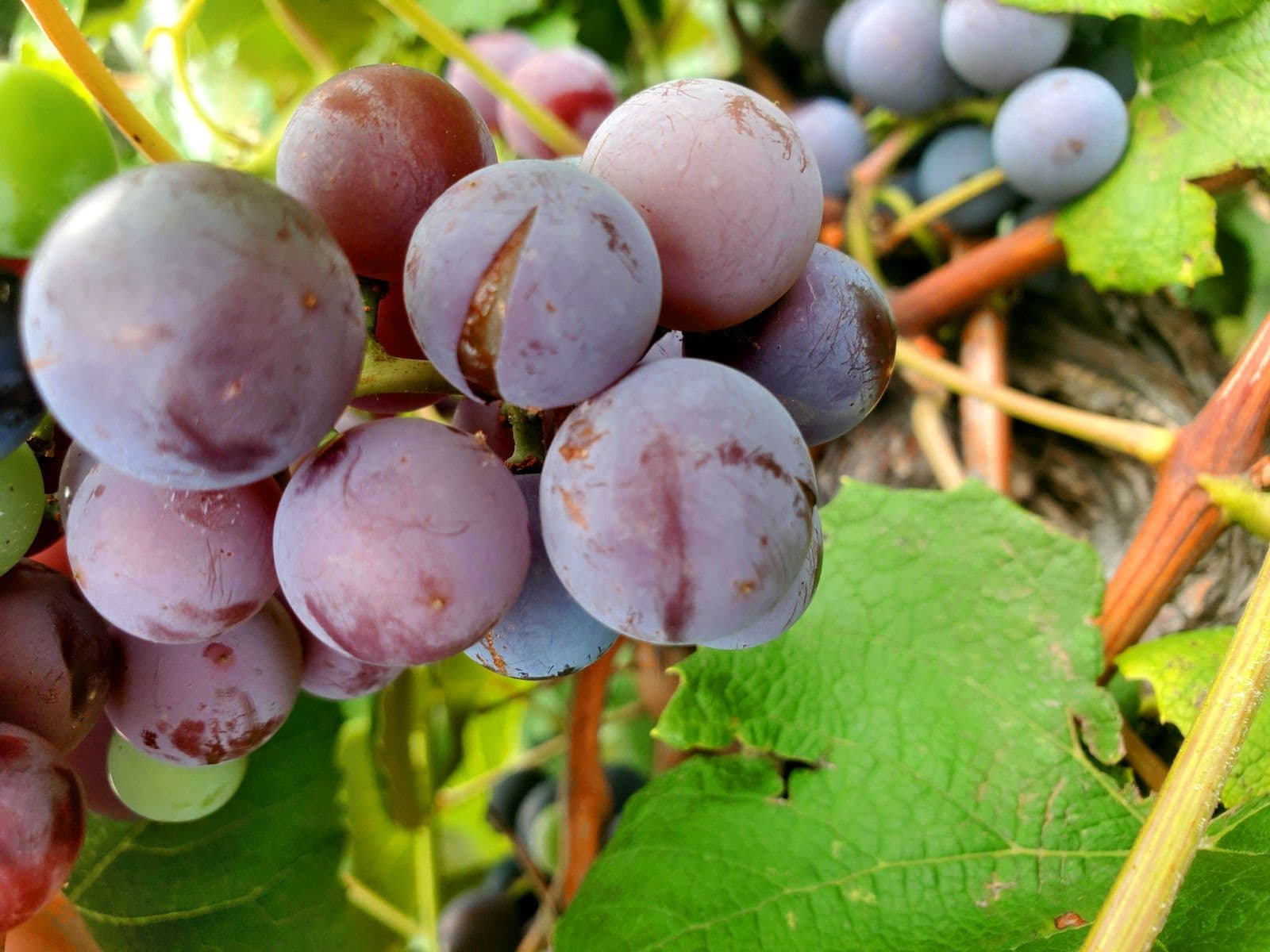
Berry cracking is an eco-physiological disorder in which grape berries split open during ripening, typically after rainfall. It occurs when internal turgor pressure — driven by osmotic water absorption — exceeds the mechanical strength of the berry skin.
The disorder is particularly damaging in *Vitis vinifera* table grape varieties like Thompson Seedless, the dominant export cultivar in Maharashtra. Cracked berries decompose rapidly, producing ethyl acetate and acetic acid, which render affected bunches unmarketable and can contaminate wine must.
India's grape sector covers 155,300 hectares and produces 3,262,400 MT annually, with table grape exports valued at US$305.66 million (APEDA data). Even a 10–20% incidence of berry cracking during the export-critical Rabi ripening window represents significant revenue loss for growers.
Why Does Berry Cracking Happen in Thompson Seedless Grapes?
Berry cracking is fundamentally a water-balance problem. As grapes ripen, their total soluble solids (TSS) — primarily sugars — increase. These sugars act as solutes, drawing water into the berry through osmosis when external moisture is available.
Water enters the berry through two pathways. The first is root uptake via the vine's vascular system. The second is direct absorption through the berry skin when rain or dew coats the fruit surface.
When the rate of water inflow exceeds the rate of transpiration (water loss through the skin), pressure builds inside the berry. If this turgor pressure exceeds the skin's tensile strength, the berry cracks. In practice, berry skin extensibility decreases sharply in the two to three weeks before harvest, while enzymatic activity — particularly pectin methyl esterase — thins the cell walls during ripening, making the fruit increasingly fragile at the stage when it is most exposed to risk.
> Field insight: Growers often notice cracking three days after a rain event, not immediately. The delay reflects the time required for osmotic pressure to build past the skin's breaking point. This 72-hour lag is also what makes prediction — and preventive action — possible.
What Six Environmental Factors Predict Berry Cracking?
Six measurable environmental parameters, captured by on-farm IoT weather stations and soil sensors, determine whether and how severely berry cracking occurs. Research conducted across 50 Thompson Seedless vineyards in Nashik district (Maharashtra) by the Fyllo R&D team identified and quantified these relationships [EXTERNAL LINK: Indian Journal of Horticulture — DOI: 10.58993/ijh/2024.81.2.13].
Factors with a positive relationship to cracking (more = higher risk)
| Factor | Affected Vineyards (Mean) | Unaffected Vineyards (Mean) | Significance | Critical Threshold |
|---|---|---|---|---|
| Growing degree days (GDD) from pruning | 1,541 | 1,456 | Highly significant | 1,415 GDD |
| Average relative humidity (%) | 73.7% | 69.6% | Highly significant | 74.1% |
| Cumulative rainfall over 3 days (mm) | 8.6 mm | 4.9 mm | Highly significant | 20.5 mm |
Factors with a negative relationship to cracking (more = lower risk)
| Factor | Affected Vineyards (Mean) | Unaffected Vineyards (Mean) | Significance | Critical Threshold |
|---|---|---|---|---|
| Average soil moisture tension (kPa) | 13.5 | 19.8 | Not significant | 31.2 kPa |
| Average maximum temperature (°C) | 30.1°C | 31.2°C | Significant | 26.6°C |
| Average wind speed (km/h) | 4.27 | 5.12 | Significant | 9.8 km/h |
How Do Growing Degree Days Influence Berry Cracking?
Growing degree days (GDD) accumulated from the date of fruit pruning are the single most influential predictor of berry cracking, with a correlation coefficient of 0.861 — stronger than any other factor.
GDD serves as a reliable proxy for the berry's TSS content. Regardless of the daily temperatures in different locations, a given GDD value corresponds to the same level of sugar accumulation. This makes it a more consistent indicator than simply counting days from pruning.
Below 1,415 GDD, the berry's sugar content is insufficient to drive enough osmotic water absorption to reach the critical turgor pressure. Above this threshold, cracking risk climbs steadily. The highest incidence was recorded at 1,700 GDD, corresponding to the advanced ripening stage when cell wall thinning by pectin methyl esterase is also at its peak.
In practice, this means rain before 1,415 GDD poses minimal cracking risk — a valuable insight for growers who might otherwise panic at any rainfall during the fruiting period.
How Does Rainfall Cause Grape Berry Cracking?
Cumulative rainfall during the three days preceding the appearance of cracking is the second most important predictor (correlation: 0.555).
No berry cracking was observed at cumulative rainfall below 3 mm. Beyond this threshold, damage escalated rapidly, reaching 67.5% cracking at 20.5 mm over 72 hours.
The three-day cumulative figure matters more than a single-day total. Rainfall distributed across multiple spells over 72 hours keeps a water film on the berry surface repeatedly, allowing more water to enter through the skin each time. A single heavy rainfall event of the same total volume is often less damaging because the water runs off more quickly.
This is a critical distinction for Maharashtra growers facing the increasing frequency of unseasonal rain events during January–March. Even light but persistent drizzle over two to three days can cause more harm than a single sharp storm.
Can High Temperature and Wind Protect Grapes from Cracking?
Yes. Both maximum temperature and wind speed showed a negative relationship with berry cracking — higher values reduce damage.
Maximum temperatures above 26.6°C were associated with declining cracking rates. At 38°C, cracking was nil. Similarly, cracking was nil at wind speeds of 9.8 km/h and highest (45.5%) at zero wind.
The mechanism is straightforward. Higher temperatures and wind accelerate evaporation of water from the berry surface, shortening the time available for osmotic absorption. They also increase transpiration through the berry skin, which relieves internal turgor.
> Pro tip for growers: Vineyards in sheltered positions with poor air circulation (low wind speed) are inherently at higher risk. Where possible, canopy management practices that improve airflow — such as appropriate shoot positioning and leaf removal around the fruiting zone — can reduce the microclimate humidity and increase wind exposure around bunches.
How Accurate Is the Berry Cracking Prediction Model?
The multiple regression function combining all six parameters is:
Y = -104.55 + 0.1723(GDD) + 0.0826(RH) + 4.1161(Rainfall) + 0.4813(SMT) - 4.5706(Tmax) - 8.0401(Wind Speed)
This model explains 92.4% of the variation in berry cracking (R² = 0.924), making it a highly reliable prediction tool.
Validation results (2024 season)
The model was validated across 23 vineyards in Sangli and Solapur districts during the January 2024 fruiting season. The average predicted cracking was 31.6% versus observed cracking of 32.5% — a non-significant deviation of just 2.2% (t-stat: 0.154 vs. t-critical: 2.18).
Individual vineyard deviations ranged from 0.5% to 4.6%, confirming the model's consistency across different locations and management practices.
This level of accuracy means growers using IoT-equipped vineyards can receive meaningful cracking risk alerts based on real-time sensor data, well before visible symptoms appear.
How Can Grape Growers Use This Model in Practice?
Translating this research into actionable on-farm decisions requires three steps:
1. Install IoT weather and soil monitoring equipment. You need continuous data on temperature, humidity, rainfall, wind speed, and soil moisture tension at the vineyard level. Fyllo's IMD-certified Kairo weather station and Nero soil moisture sensor capture all required parameters and transmit data to a cloud dashboard.
2. Track GDD from the date of fruit pruning. Once GDD crosses 1,415, your vineyard enters the cracking-susceptible window. Any rainfall forecast during this period warrants attention.
3. Monitor the three-day rolling weather window. When cumulative rainfall exceeds 3 mm, humidity is above 74%, maximum temperature drops below 26.6°C, and wind speed is below 5 km/h — these conditions together signal high cracking probability. The prediction equation can quantify the expected severity.
Preventive actions during the high-risk window include applying anti-transpirant sprays, ensuring drainage away from the root zone, adjusting irrigation to reduce soil moisture, and, where feasible, deploying protective covers over high-value export-grade bunches.
Can I Predict Berry Cracking on a Small Vineyard?
Yes. The prediction model works at the individual vineyard level regardless of farm size. During validation, it performed consistently across vineyards with berry cracking ranging from 2.4% to 79.8%.
The cost of IoT monitoring equipment has dropped significantly in recent years. Services like Fyllo offer device installation and data subscriptions that are accessible for farms as small as 2–5 acres. The real-time data feed means you do not need to manually collect weather readings — the system automates data capture and can push alerts directly to your phone through the Fyllo mobile app.
For growers managing Thompson Seedless for the export market, where a single rejected consignment can cost lakhs, the return on investment from early cracking alerts is substantial.
What Is the Best Time to Watch for Berry Cracking?
Berry cracking risk is highest during the Rabi grape ripening window — typically January through March in Maharashtra's Nashik, Sangli, and Solapur districts.
The critical period begins when GDD from fruit pruning crosses 1,415 and ends at harvest. For most Thompson Seedless vineyards in Maharashtra pruned in October, this susceptible window falls between late January and mid-March.
Unseasonal rainfall events during this period — increasingly common due to shifting weather patterns — are the primary trigger. The 2023 data in this study were collected after three consecutive days of rain in March, while the 2024 validation data came from rain events in January.
Growers should have their IoT monitoring active and operational well before this window opens, ideally from the time of fruit pruning onward.
Regional Considerations for Maharashtra Grape Growers
The prediction model was developed and validated specifically in Maharashtra's grape belt, making it directly applicable for growers in this region.
Nashik district — the primary Thompson Seedless growing area and the source of the model's development data — faces moderate risk from western disturbance-driven rainfall during February–March. Sangli and Solapur districts — where the model was validated — experience a drier climate overall but are increasingly affected by erratic rain events during the January harvest window.
Soil type influences soil moisture dynamics. The basaltic black cotton soils common in parts of Sangli and Solapur retain moisture longer than the lighter soils around Nashik, potentially extending the period of root-zone water availability after rainfall. Growers on heavier soils should pay extra attention to the soil moisture tension readings from their sensors.
Conclusion
Berry cracking in Thompson Seedless grapes is no longer an unpredictable act of nature. A six-factor regression model built from IoT weather station and soil sensor data predicts cracking severity with 92.4% accuracy, giving growers a 72-hour early warning window to take protective action. If you grow Thompson Seedless in Maharashtra, the most impactful step you can take is installing vineyard-level weather monitoring and tracking GDD from the date of fruit pruning — this single metric is the strongest predictor of when your crop enters the danger zone.
*Last updated: June 2026*