What is Delta T?
Delta T is the difference between the air temperature and the dew point temperature. It serves as an indicator of atmospheric humidity and how quickly evaporation is likely to occur — a critical factor for timing spray applications and managing crop inputs efficiently.
Key Takeaways
- The ideal Delta T range for spraying is 2°C to 8°C — outside this window, spray drift and poor coverage increase significantly.
- VPD between 0.2 and 1.0 kPa is optimal for most crops, balancing healthy transpiration with efficient water and nutrient uptake.
- Monitoring both Delta T and VPD together enables farmers to time spraying, irrigation, and fertigation with precision — reducing waste and preventing crop stress.
Delta T in Agriculture
When Delta T is higher, it signals drier air — meaning water and spray droplets evaporate more quickly. A lower Delta T points to more humid conditions where evaporation is slower, allowing droplets to linger in the air longer.
Understanding this relationship is essential for planning any field operation where evaporation rate matters, from pesticide application to foliar feeding.
How Delta T Helps in Spray Timing
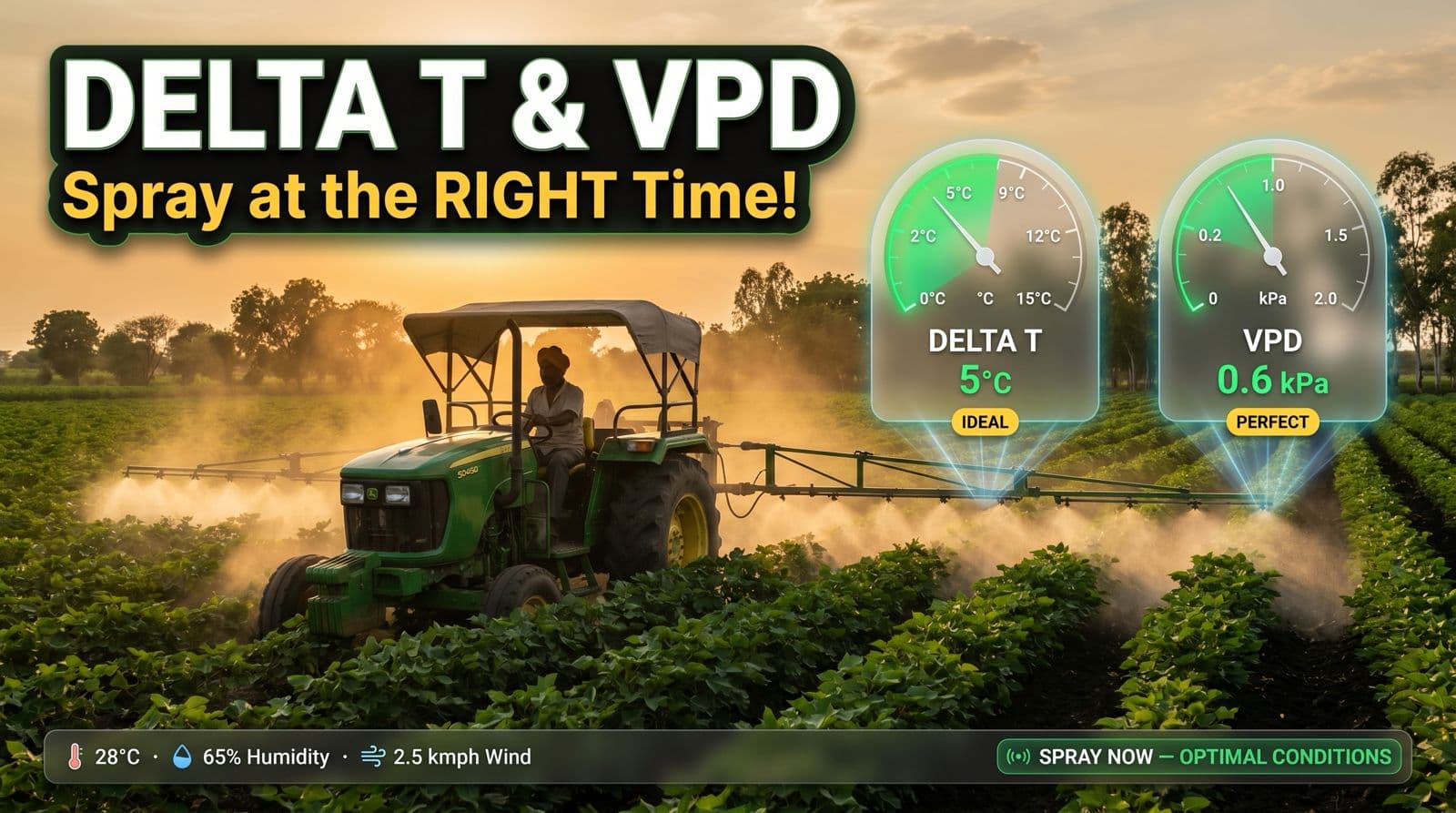
For agricultural spraying, the ideal Delta T range is between 2°C and 8°C.
When Delta T Drops Below 2°C High humidity increases the risk that spray droplets remain suspended in the air for too long, leading to spray drift and poor coverage on the target crop.
When Delta T Climbs Above 8°C The air becomes too dry and spray droplets evaporate before reaching their target, reducing effectiveness and again increasing drift risk.
Selecting the right Delta T window ensures that chemical applications — whether pesticides, herbicides, or foliar fertilizers — reach their targets effectively. This minimizes waste, avoids damage to non-target areas, and supports sustainable farming practices.
Enhancing Spray Decisions with Additional Weather Data
Delta T alone doesn't tell the full story. Integrating other weather parameters improves spray timing decisions significantly:
- Wind speed — High winds increase spray drift risk even when Delta T is within the ideal range.
- Leaf wetness — Wet leaf surfaces affect how chemicals are absorbed by the plant.
- Humidity — Ambient humidity levels influence droplet behaviour and drying time.
Combining these factors into spray planning ensures applications are made under optimal conditions, maximizing effectiveness and minimizing losses.
What is VPD (Vapor Pressure Deficit) in Agriculture?
Vapor Pressure Deficit, or VPD, measures the difference between the amount of moisture the air could hold when fully saturated and the amount it actually holds. It acts as a strong indicator of the atmosphere's drying power and helps explain how vigorously plants lose water through transpiration.
VPD and Crop Water Management
When VPD Is Too High Plants lose water rapidly through their leaves. While some transpiration is necessary and healthy, excessively high VPD — especially during hot summer months — can place plants under significant water stress. This leads to slowed growth, reduced yields, and even permanent crop damage if irrigation doesn't compensate adequately.
When VPD Is Too Low Plants transpire very little. This might seem positive, but reduced transpiration lowers nutrient uptake. Combined with over-irrigation, it can cause leaching of fertilizers beyond the root zone — wasting inputs and potentially harming soil health.
What Is the Ideal VPD in Agriculture?
For most crops, the optimal VPD range is between 0.2 and 1.0 kPa. Within this window, plants are actively transpiring without being stressed, ensuring water and fertilizers are used efficiently.
Monitoring VPD is particularly critical during summer months when temperatures are high and VPD values can spike sharply. For example, if VPD readings climb quickly in the late morning, it may be necessary to irrigate earlier in the day to keep plants hydrated before the atmosphere pulls too much moisture away. Similarly, fertigation strategies can be adjusted so nutrients are delivered when plants are actively taking them up — reducing waste and improving results.
How Smart Monitoring Tools Help
By actively monitoring Delta T, VPD, and other microclimatic data using smart agricultural tools like Fyllo's Kairo microclimate sensor and AI-powered advisory platform, farmers can improve spray efficiency, prevent crop stress, maximize yield potential, and practise climate-smart farming.
Adopting these agronomic best practices leads to resource-efficient farming, healthier crops, and better returns — aligning with both economic and environmental goals.